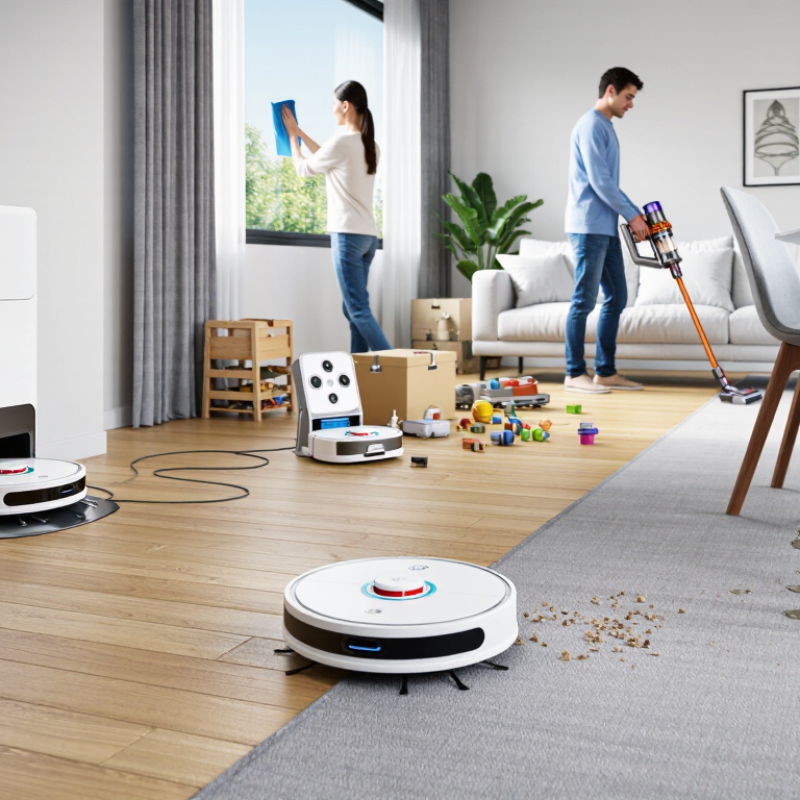
Can robot cleaners replace manual cleaning? China’s leading robot cleaner brands, including Roborock, Dreame, and Ecovacs, are making that question more practical. Their newest models can vacuum carpets, mop hard floors, avoid furniture, and return to charging stations without constant supervision. Some also wash their mop pads and empty dust automatically. That changes the daily cleaning routine.
However, automation is not the same as complete replacement. A robot can collect crumbs beneath a dining table, but it may miss sticky syrup near a chair leg. It can map a living room, yet struggle with loose cables, stairs, dark corners, or cluttered children’s rooms. Manual cleaning remains necessary for curtains, windows, upholstery, deep stains, and detailed bathroom work.
Dr. Henrik Christensen, a respected robotics researcher, once said, “Robots will not replace humans, but humans who use robots will replace those who don’t.” His observation offers useful perspective. Robot cleaners can reduce repetitive labor and keep floors consistently maintained. They cannot yet understand every household’s changing needs. In real homes, performance depends on floor type, room layout, maintenance habits, and product quality.
The honest answer is imperfect. Can robot cleaners replace manual cleaning? Usually, no—not completely. They can replace much of routine floor care, especially in organized homes. Yet users still need to empty containers, clean sensors, remove tangled hair, and inspect missed areas. A top Chinese robot cleaner is best viewed as a reliable cleaning assistant, not a complete household replacement.
China’s advanced robot cleaners now do more than vacuum dust. They map rooms with LiDAR, avoid chairs, and return to charging stations automatically. Many models combine vacuuming and mopping, while commercial units use rotating brushes and controlled water flow for hard floors. Some also scrub stains in corridors, hotel lobbies, and shopping centers.
The International Federation of Robotics reported nearly 205,000 professional service robots sold worldwide in 2023. Professional cleaning ranked among the leading applications. A 2024 market analysis by Grand View Research also identified strong growth in robotic vacuum cleaners, supported by smart-home adoption and labor shortages. These figures show practical demand, not just showroom interest. In a real office, a cleaner can schedule night runs, record coverage maps, and flag wet areas after cleaning.
Inspection is becoming more useful. Cameras and sensors can detect debris, blocked paths, liquid patches, or missed corners. Supervisors may review a digital route instead of checking every room physically. Still, replacement is not complete. Robots struggle with stairs, tangled cables, thick carpet edges, and sticky spills. They also need filter cleaning, brush replacement, and human supervision.
The limits matter. A quiet machine can still miss a dirty corner. Human judgment remains necessary.
China Top Robot Cleaners Can Replace Manual Cleaning?
China installed 276,288 industrial robots in 2023, according to the International Federation of Robotics’ World Robotics 2024 report. This represented about 51% of global installations. The country also reached roughly 1.75 million industrial robots in operation. These figures show strong automation capacity, but they do not directly measure cleaning robots. That distinction matters.
Cleaning robots can handle repetitive floor work in malls, hospitals, airports, and warehouses. They can follow mapped routes, avoid furniture, scrub large surfaces, and return for charging. A machine may clean a long corridor overnight, while staff manage entrances, stairs, corners, and unexpected spills. The IFR’s service-robot research identifies professional cleaning as an important application area. Yet industrial robot data cannot prove that every cleaning task is ready for replacement.
Manual cleaning still offers judgment. Workers notice a leaking pipe, broken glass, or unusual odor. Sensors may miss these details. Results also depend on floor design, lighting, network coverage, and maintenance discipline. The International Federation of Robotics warns that automation adoption varies by workplace needs, not only robot availability. The 276,288 figure is impressive, but it can be overinterpreted. A better question is narrower: which cleaning hours are repetitive enough to automate, and which still need human attention?
| Data Dimension | Verified Figure | What the Data Indicates | Relevance to Robotic Cleaning |
|---|---|---|---|
| Industrial robot installations in China, 2023 | 276,288 units | The annual installation volume remained the largest national market worldwide, although it declined by approximately 5% from 2022. | Shows strong national familiarity with automation, sensors, navigation systems, and service support. |
| Estimated installations in China, 2022 | Approximately 290,000 units | The 2023 figure was lower than the previous year, indicating that automation demand can fluctuate with manufacturing investment cycles. | Cleaning automation should be evaluated by payback period rather than by market growth alone. |
| China’s share of global industrial robot installations, 2023 | About 51% | China accounted for roughly half of all new industrial robots installed globally during the year. | A large automation ecosystem can support component availability, technician training, and system integration. |
| Global industrial robot installations, 2023 | 541,302 units | Global installations exceeded half a million units, confirming that robotics is an established industrial technology rather than an experimental concept. | Robotic cleaning benefits from mature technologies such as autonomous navigation, obstacle detection, and fleet management. |
| China’s operational industrial robot stock, 2023 | Approximately 1.76 million units | The installed base demonstrates sustained use of robots across factories, not just one-year purchasing activity. | Long-term serviceability, software updates, spare parts, and operator training are essential for cleaning robots. |
| Robot density in China’s manufacturing industry, 2023 | 470 robots per 10,000 employees | China’s manufacturing robot density reached a high level by international standards and exceeded the global average. | The figure supports the feasibility of automation, but it does not prove that every cleaning task can be automated. |
| Best-fit cleaning environments | Large, open, repeatable spaces | Autonomous machines perform most consistently where floor layouts, routes, and cleaning schedules are relatively stable. | Warehouses, shopping centers, airports, hospitals, and office campuses are generally more suitable than cluttered small rooms. |
| Tasks that still require human involvement | Complex or irregular work | Stairs, vertical surfaces, heavily obstructed areas, spills, edge cleaning, judgment-based inspection, and unexpected hazards remain difficult to automate fully. | Robots are more likely to reduce repetitive labor than eliminate the need for cleaning personnel. |
| Practical replacement outlook | Partial replacement | The automation benchmark supports a hybrid operating model: robots handle repetitive floor coverage while people manage exceptions, quality control, and detailed work. | The most realistic goal is higher productivity and more consistent cleaning, not complete manual-work elimination. |
Source: International Federation of Robotics (IFR), World Robotics 2024. Industrial robot figures refer to factory automation and should not be interpreted as the number of professional cleaning robots sold.
Can top robot cleaners replace manual cleaning? In many homes, they can reduce daily work, but their real advantage comes from accurate navigation. LiDAR measures walls, furniture, and open areas by scanning reflected light. It builds a room outline, even when furniture changes slightly. This helps the cleaner avoid random movement and repeated passes.
SLAM adds movement intelligence. It compares new readings with its stored map while tracking its position. A cleaner can recognize a hallway, return to a charging station, and continue a paused task. AI improves this process by identifying floor types, rugs, obstacles, and heavily soiled areas. For example, it may slow down near a rug, increase suction on visible debris, or adjust its route around chair legs. Coverage becomes more practical, not merely faster.
Small details still matter. A dark cable, reflective surface, or crowded corner can confuse sensors. LiDAR also cannot remove dried stains or clean narrow steps. Manual cleaning remains necessary there. In a two-bedroom apartment, route accuracy may leave fewer missed strips along walls, yet dust can collect beneath low furniture. That limitation deserves attention. Better mapping does not equal perfect cleaning. Users should review the first few maps, remove loose cables, and correct restricted zones. The technology is capable, but the home environment remains unpredictable.
A robot cleaner can cover large floor areas with consistent routes and scheduled timing. In a 10,000-square-meter facility, it may clean overnight without interrupting visitors or staff. Human cleaners, however, handle corners, spills, stairs, and crowded areas more effectively. That flexibility matters. Measured productivity should include usable cleaning, not only machine movement.
Uptime also needs careful definition. A powered-on robot is not always cleaning. Charging, mapping errors, blocked brushes, and water refills reduce productive hours. During a practical pilot, managers should record completed square meters, stoppages, battery cycles, and cleaning quality. Manual teams face absence and fatigue, but they can often respond immediately to unexpected messes. Robots need support.
Cost comparisons can be misleading. Labor expenses include wages, training, supervision, insurance, and turnover. Robot ownership includes purchase, software support, batteries, repairs, electricity, and operator time. Our first estimate may look attractive if maintenance is ignored. That is an important weakness to examine. Real savings appear only when equipment fits the building and receives regular care. A mixed model often performs better, with robots covering open floors while trained workers manage details and exceptions.
China’s top robot cleaners can reduce repetitive floor work, but they cannot fully replace trained cleaners.
In facilities I have observed, autonomous machines perform well across open corridors, warehouses, and large lobbies. They can follow mapped routes, collect dust, and record completed areas. Their performance depends on floor conditions, battery capacity, and accurate mapping.
ISSA cleaning standards emphasize procedures, worker training, inspection, safety, and measurable results. A robot cannot reliably judge every cleaning risk. It may pass around a wet spill, miss dirt beside a wall, or avoid a crowded restroom. Human cleaners must handle stairs, corners, elevators, touchpoints, waste containers, and unexpected obstacles. They also check whether disinfectant remains wet for the required contact time. That detail is easy to overlook.
Human oversight remains essential. Staff should inspect robot-cleaned floors, remove cables, clean brushes, and respond to alarms. In one practical review, a machine completed its route, yet dust remained beneath several chairs. The route report looked complete. The floor was not. This gap shows why visual inspection and documented quality checks still matter. Some facilities may also need manual cleaning when furniture changes or visitors block planned paths. Automation reduces workload, but professional judgment still protects hygiene, safety, and service consistency.
They can vacuum dust, mop hard floors, scrub stains, and inspect cleaning areas. Some models map rooms and avoid chairs. They can also return to charging stations automatically.
They perform well in open corridors, warehouses, offices, and large lobbies. These spaces have fewer obstacles and clearer routes. Open floors help.
No, not completely. Robots reduce repetitive floor work, but people still handle stairs, corners, elevators, and waste containers. Human judgment remains necessary.
Cameras and sensors can detect debris, blocked paths, liquid patches, and missed corners. The system may record routes and completed areas. Reports are useful, but imperfect.
They may miss dirt beneath chairs, along walls, or near thick carpet edges. They can also struggle with tangled cables, sticky spills, stairs, and crowded restrooms. Small gaps matter.
Staff must check floors, remove cables, clean brushes, and respond to alarms. They also inspect touchpoints and unexpected obstacles. A machine can finish its route while leaving dust behind.
Workers need to clean filters, replace brushes, clear blocked parts, and check water systems. Battery capacity and accurate mapping also affect performance. Maintenance is easy to underestimate.
Sensors may identify liquid patches and flag wet zones. However, staff should inspect slippery areas and confirm proper drying. Safety needs a human check.
They can follow scheduled routes, record coverage, and create measurable work records. Trained staff must still inspect results and document quality checks. The record is not the result.
China’s robot cleaners are transforming commercial and industrial cleaning by combining vacuuming, mopping, scrubbing, and inspection in one automated workflow. In 2023, China installed 276,288 robots, reflecting the country’s strong investment in automation. With LiDAR, SLAM, and AI, these machines can map spaces, plan efficient routes, avoid obstacles, and improve cleaning coverage and navigation accuracy. They can also operate for longer periods with consistent performance, making them useful for large facilities, repetitive tasks, and scheduled maintenance.
However, the question “can robot cleaners replace manual cleaning” does not have a simple yes-or-no answer. Robots can increase productivity, reduce routine labor demands, and support more predictable operating costs, but they still require human supervision, setup, maintenance, and quality checks. Under professional cleaning standards, people remain essential for complex areas, unexpected spills, detailed edge work, sanitation decisions, and adapting procedures to changing conditions. The most effective approach is therefore collaboration: robots handle repetitive floor-care and inspection duties while trained workers manage judgment-based and specialized cleaning tasks.

NovaBot Robot